ARIA Global Notes:
Redefining Collaboration in Legacy Systems
Enhancing team collaboration in ARIA ATMS by replacing legacy fragmented communication with centralized, timestamped logs and clear author attribution.
STAKEHOLDERS
Traffic management center
(DURHAM AND WATERLOO)
Traffic management center
(DURHAM AND WATERLOO)
Year
FEB 2024 - APR 2024
Role
UX DESIGNer
Deliverables
Hi-Fi Design Prototypes
Hi-Fi Design Prototypes

PROBLEM & High-stakes friction
A decade old system managing regional traffic signals, relied on an outdated text box for logging operational changes. Because notes lacked timestamps and author attribution, operators stopped using them.
Operational Blindspots:
Analysts couldn’t tell who made configuration changes or when.
Communication Breakdowns:
Teams resorted to endless email chains and verbal handoffs to track system updates.
Real-World Incident:
During a major intersection breakdown, Team A applied a temporary configuration fix and left an untimestamped note. Team B unknowingly overwrote the fix hours later, causing secondary traffic delays and team friction.


KEY USER INSIGHT
Traffic Analyst, Durham Region TMC
“When I change a traffic light’s timing, I don’t write it down because the current note section doesn’t show who added it or when. If something goes wrong, no one knows who to ask.”
The 3 Pillars of the Solution
Automatic Authorship & Timestamps:
Every note auto-generates the author’s name and precise time-log, creating immediate operational accountability across regional control rooms.
Multi-Level Contextual Pinning:
Solved complex nested entity structures by enabling operators to pin notes at specific signal levels or globally across the system.
Smart Handling of Orphaned Notes:
Engineered an “Orphaned Notes” filter so historical logs remain intact as audit proof even if an underlying traffic signal or schedule is deleted.
FINAL SCREENS
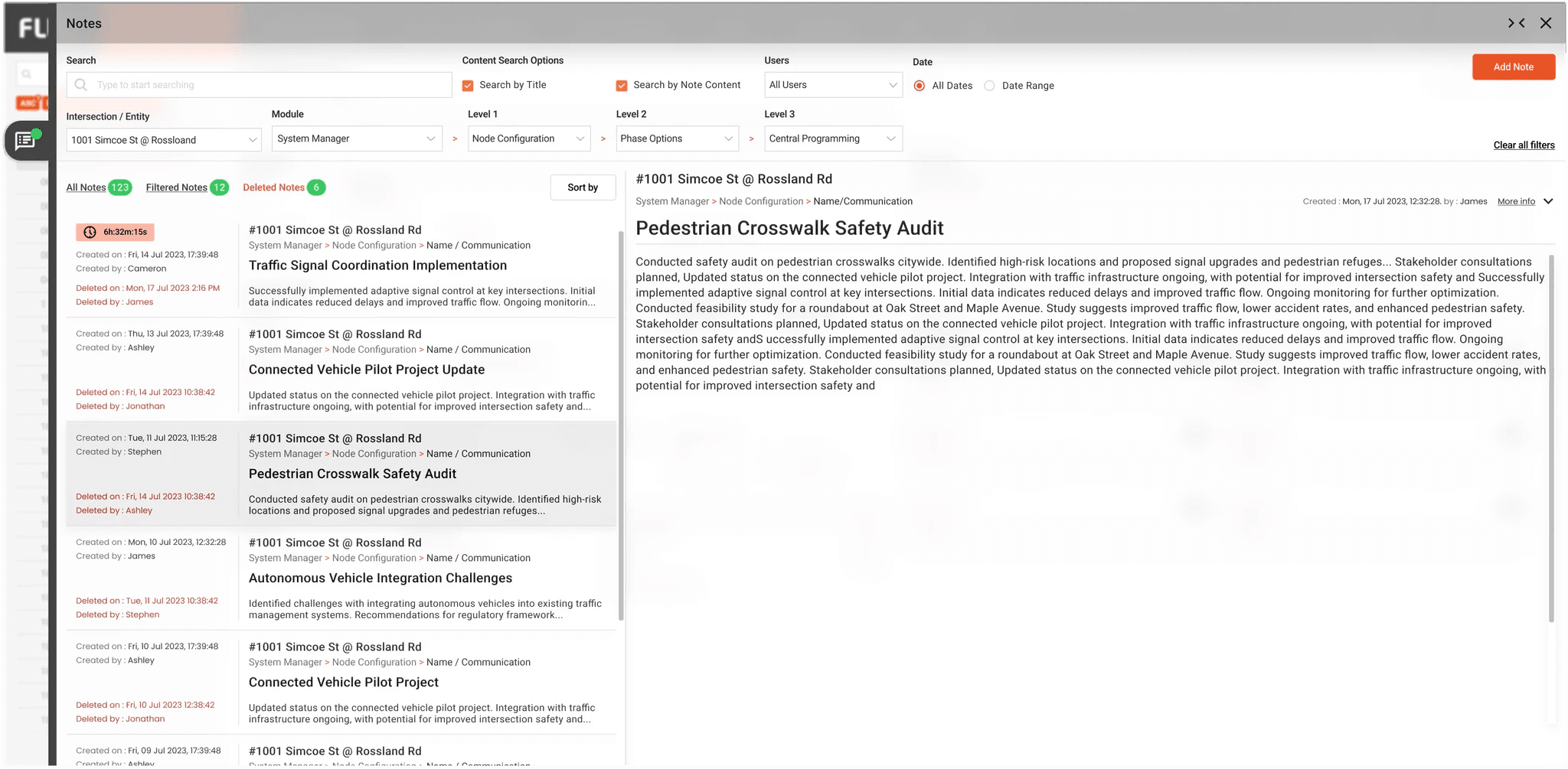
Context-Aware Side Drawer: Zero Workflow Interruption
Designed as an ever present side overlay, Global Notes automatically maps logs to the operator’s current view—enabling rapid reference and seamless task continuation.


What went wrong & Iteration
challenge
Nested Layer Ambiguity Testing Insight: Early wireframes showed users were confused about which sub-level a note belonged to.
solution
Introduced hierarchical visual badges so users instantly know if a note applies to an entire intersection or a single signal phase.
challenge
Data Loss on Deleted Objects Testing Insight: Deleting a traffic signal schedule created orphaned data.
solution
Instead of purging notes, we preserved them in an “Orphaned Category” to maintain a complete historical paper trail for regional compliance.
PROBLEM & High-stakes friction
A decade old system managing regional traffic signals, relied on an outdated text box for logging operational changes. Because notes lacked timestamps and author attribution, operators stopped using them.
Operational Blindspots:
Analysts couldn’t tell who made configuration changes or when.
Communication Breakdowns:
Teams resorted to endless email chains and verbal handoffs to track system updates.
Real-World Incident:
During a major intersection breakdown, Team A applied a temporary configuration fix and left an untimestamped note. Team B unknowingly overwrote the fix hours later, causing secondary traffic delays and team friction.
KEY USER INSIGHT
Traffic Analyst, Durham Region TMC
“When I change a traffic light’s timing, I don’t write it down because the current note section doesn’t show who added it or when. If something goes wrong, no one knows who to ask.”
The 3 Pillars of the Solution
Automatic Authorship & Timestamps:
Every note auto-generates the author’s name and precise time-log, creating immediate operational accountability across regional control rooms.
Multi-Level Contextual Pinning:
Solved complex nested entity structures by enabling operators to pin notes at specific signal levels or globally across the system.
Smart Handling of Orphaned Notes:
Engineered an “Orphaned Notes” filter so historical logs remain intact as audit proof even if an underlying traffic signal or schedule is deleted.
FINAL SCREENS
Context-Aware Side Drawer: Zero Workflow Interruption
Designed as an ever present side overlay, Global Notes automatically maps logs to the operator’s current view—enabling rapid reference and seamless task continuation.
What went wrong & Iteration
challenge
Nested Layer Ambiguity Testing Insight: Early wireframes showed users were confused about which sub-level a note belonged to.
solution
Introduced hierarchical visual badges so users instantly know if a note applies to an entire intersection or a single signal phase.
challenge
Data Loss on Deleted Objects Testing Insight: Deleting a traffic signal schedule created orphaned data.
solution
Instead of purging notes, we preserved them in an “Orphaned Category” to maintain a complete historical paper trail for regional compliance.
PROBLEM & High-stakes friction
A decade old system managing regional traffic signals, relied on an outdated text box for logging operational changes. Because notes lacked timestamps and author attribution, operators stopped using them.
Operational Blindspots:
Analysts couldn’t tell who made configuration changes or when.
Communication Breakdowns:
Teams resorted to endless email chains and verbal handoffs to track system updates.
Real-World Incident:
During a major intersection breakdown, Team A applied a temporary configuration fix and left an untimestamped note. Team B unknowingly overwrote the fix hours later, causing secondary traffic delays and team friction.
KEY USER INSIGHT
Traffic Analyst, Durham Region TMC
“When I change a traffic light’s timing, I don’t write it down because the current note section doesn’t show who added it or when. If something goes wrong, no one knows who to ask.”
The 3 Pillars of the Solution
Automatic Authorship & Timestamps:
Every note auto-generates the author’s name and precise time-log, creating immediate operational accountability across regional control rooms.
Multi-Level Contextual Pinning:
Solved complex nested entity structures by enabling operators to pin notes at specific signal levels or globally across the system.
Smart Handling of Orphaned Notes:
Engineered an “Orphaned Notes” filter so historical logs remain intact as audit proof even if an underlying traffic signal or schedule is deleted.
FINAL SCREENS
Context-Aware Side Drawer: Zero Workflow Interruption
Designed as an ever present side overlay, Global Notes automatically maps logs to the operator’s current view—enabling rapid reference and seamless task continuation.
What went wrong & Iteration
challenge
Nested Layer Ambiguity Testing Insight: Early wireframes showed users were confused about which sub-level a note belonged to.
solution
Introduced hierarchical visual badges so users instantly know if a note applies to an entire intersection or a single signal phase.
challenge
Data Loss on Deleted Objects Testing Insight: Deleting a traffic signal schedule created orphaned data.
solution
Instead of purging notes, we preserved them in an “Orphaned Category” to maintain a complete historical paper trail for regional compliance.
PROBLEM & High-stakes friction
A decade old system managing regional traffic signals, relied on an outdated text box for logging operational changes. Because notes lacked timestamps and author attribution, operators stopped using them.
Operational Blindspots:
Analysts couldn’t tell who made configuration changes or when.
Communication Breakdowns:
Teams resorted to endless email chains and verbal handoffs to track system updates.
Real-World Incident:
During a major intersection breakdown, Team A applied a temporary configuration fix and left an untimestamped note. Team B unknowingly overwrote the fix hours later, causing secondary traffic delays and team friction.
KEY USER INSIGHT
Traffic Analyst, Durham Region TMC
“When I change a traffic light’s timing, I don’t write it down because the current note section doesn’t show who added it or when. If something goes wrong, no one knows who to ask.”
The 3 Pillars of the Solution
Automatic Authorship & Timestamps:
Every note auto-generates the author’s name and precise time-log, creating immediate operational accountability across regional control rooms.
Multi-Level Contextual Pinning:
Solved complex nested entity structures by enabling operators to pin notes at specific signal levels or globally across the system.
Smart Handling of Orphaned Notes:
Engineered an “Orphaned Notes” filter so historical logs remain intact as audit proof even if an underlying traffic signal or schedule is deleted.
FINAL SCREENS
Context-Aware Side Drawer: Zero Workflow Interruption
Designed as an ever present side overlay, Global Notes automatically maps logs to the operator’s current view—enabling rapid reference and seamless task continuation.
What went wrong & Iteration
challenge
Nested Layer Ambiguity Testing Insight: Early wireframes showed users were confused about which sub-level a note belonged to.
solution
Introduced hierarchical visual badges so users instantly know if a note applies to an entire intersection or a single signal phase.
challenge
Data Loss on Deleted Objects Testing Insight: Deleting a traffic signal schedule created orphaned data.
solution
Instead of purging notes, we preserved them in an “Orphaned Category” to maintain a complete historical paper trail for regional compliance.